📌 Key Takeaways
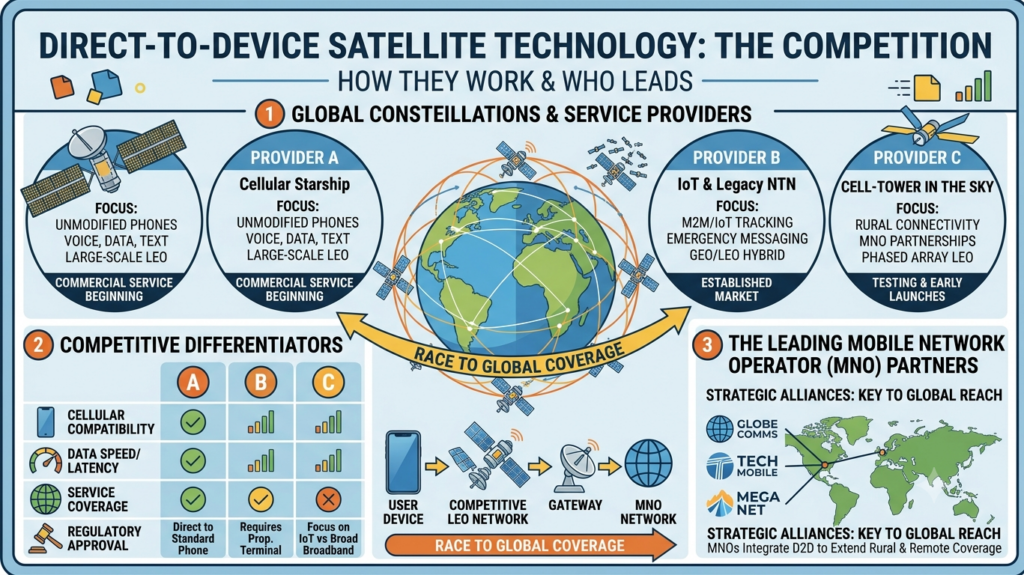
- Direct to device satellite technology now spans two fundamentally different architectures — carrier-spectrum “bent pipe” systems (Starlink Direct to Cell, AST SpaceMobile) and dedicated satellite-spectrum systems (Globalstar/Apple, Iridium) — and each solves the link-budget problem differently.
- AST SpaceMobile has deployed seven BlueBird satellites as of April 2026, including BlueBird 7 with roughly 2,400 square feet of active phased-array antenna, and has signed more than 50 mobile network operator (MNO) partners representing an analyst-estimated 3 billion subscribers.
- Starlink’s direct-to-cell constellation exceeded 650 satellites by early 2026, according to industry trackers, giving it the largest 4G-equivalent coverage footprint of any D2D network by geographic area, though its per-satellite antenna aperture is smaller than AST’s.
- 3GPP’s Non-Terrestrial Network (NTN) Release 19 froze in December 2025, setting the stage for regenerative-payload and RedCap device support that analysts expect to mature through 2027, gradually shifting the market from proprietary bent-pipe links toward standardized NTN roaming.
Direct to device satellite technology — the ability to connect an unmodified consumer smartphone directly to a satellite without a dish, hotspot, or bulky terminal — has moved from demonstration to early commercial deployment faster than most link-budget skeptics expected two years ago. The core challenge has always been physics: a handset’s tiny internal antenna and roughly 200 milliwatt transmit power were never designed to close a link across 500-600 km of free space to a satellite moving at 7.5 km/s. Closing that gap has produced two distinct commercial strategies, and by mid-2026 both are generating real traffic.
On this page
- The Link Budget Problem at the Center of Direct to Device Satellite Technology
- Carrier-Spectrum vs. Satellite-Spectrum Business Models
- Player-by-Player: Who Leads in Direct to Device Satellite Deployment
- NTN Standards: The Long-Term Path to Interoperability
- Regulatory and Spectrum-Sharing Constraints on Direct to Device Satellite Technology
- Competitive and Coverage Economics
- Industry Implications
- What to Watch
The first strategy — pursued by AST SpaceMobile and Starlink’s Direct to Cell — leases terrestrial cellular spectrum from mobile network operators and uses an enormous satellite-side phased-array antenna to compensate for the handset’s weak, unmodified radio. The second — pursued by Globalstar (Apple’s satellite partner) and Iridium — uses dedicated satellite spectrum and specialized handset firmware, trading broader bandwidth ambitions for a link budget that is easier to close at lower satellite complexity. This article breaks down how each link budget is closed, who leads on deployment and standards, and what the NTN roadmap means for direct to device satellite technology buyers in 2026.
The Link Budget Problem at the Center of Direct to Device Satellite Technology
A standard LTE or 5G link budget assumes a base station with a multi-meter tower-mounted antenna array talking to a handset a few kilometers away. Direct to device satellite technology inverts that geometry: the “tower” is 500-600 km away in low Earth orbit, moving at orbital velocity, while the handset’s antenna gain and transmit power stay unchanged from a terrestrial call.
Free-space path loss scales with the square of distance, so moving from a 1 km terrestrial link to a 550 km satellite link increases path loss by roughly 55 dB — a factor of more than 300,000 in raw signal power. Closing that gap without modifying the phone requires either a satellite antenna array large enough to concentrate power and sensitivity into a narrow, high-gain spot beam aimed at a handset-sized patch of Earth, or accepting a much lower data rate — enough for SMS and basic voice but not broadband.
Why Antenna Size Is the Real Differentiator
AST SpaceMobile’s BlueBird satellites carry what the company and independent trackers describe as the largest commercial phased-array antennas ever flown in LEO — BlueBird 7, launched April 12, 2026, reportedly carries an active antenna surface of roughly 2,400 square feet. That scale directly addresses the link-budget math: a larger aperture concentrates more gain into a narrower beam, allowing AST to target broadband-class throughput — tens of Mbps peak, per company statements — rather than SMS-only service.
Starlink’s direct-to-cell satellites use a smaller, flat-panel phased array bolted onto the standard Starlink v2 mini bus, sacrificing some per-satellite link-budget headroom relative to AST’s purpose-built platform. Starlink compensates with sheer numbers — trackers reported more than 650 direct-to-cell satellites in orbit by early 2026 — spreading capacity across many satellites rather than concentrating it in fewer, larger ones. [INTERNAL LINK: Starlink fleet economics and IPO outlook → Starlink profile article]
Carrier-Spectrum vs. Satellite-Spectrum Business Models
The commercial structure of a D2D network follows directly from its spectrum strategy, and the two models create very different competitive dynamics for carriers evaluating partnerships.
Carrier-Spectrum (Bent-Pipe) Model
AST SpaceMobile and Starlink Direct to Cell both operate as a “bent pipe” extension of a partner MNO’s existing spectrum license — the satellite relays the carrier’s own LTE/5G signal from orbit rather than broadcasting on separate frequencies. This is why no firmware update is required: to the handset, the satellite looks like an unusually distant cell tower.
The tradeoff is regulatory and commercial complexity. AST needs a spectrum-sharing agreement with each carrier in each country — the company has stated more than 50 MNO partnerships representing an analyst-estimated 3 billion subscribers, but each market requires separate approval and revenue-sharing terms. Starlink’s T-Mobile partnership (marketed as T-Satellite) and its Kyivstar deal in Ukraine — pegged at more than 5 million connections and over 7 million SMS messages transmitted as of March 2026 — follow the same country-by-country model.
Satellite-Spectrum (Dedicated) Model
Globalstar’s arrangement with Apple, and Iridium’s messaging services, instead use spectrum the operator already owns outright — Globalstar’s MSS (Mobile Satellite Service) allocation, in Apple’s case. Because the operator doesn’t need to negotiate spectrum access with every carrier, this model scales internationally faster. The cost is capability: without a carrier’s high-power spectrum or AST-scale antenna apertures, these networks are generally limited to emergency SOS, basic messaging, and (as of 2026) an expanding iMessage/SMS tier — rather than voice or broadband data.
Player-by-Player: Who Leads in Direct to Device Satellite Deployment
No single company leads on every axis. AST SpaceMobile leads on per-satellite technical capability and MNO partnership breadth; Starlink leads on deployed satellite count and near-term coverage area; Globalstar/Apple leads on device install base and simplicity of the emergency-messaging use case; Lynk Global has been first-to-market in several emerging markets with a narrower, SMS-focused service.
AST SpaceMobile
As of April 2026, AST had seven BlueBird satellites in orbit and was targeting 45-60 by year-end, per company statements and SEC filings. Commercial service is not yet continuous — AST has targeted H2 2026 activation with intermittent coverage windows that should become more continuous as the constellation grows. [INTERNAL LINK: AST SpaceMobile technology and funding profile → AST SpaceMobile article]
Starlink Direct to Cell
Starlink’s advantage is manufacturing velocity — the direct-to-cell payload rides on the same production line as its broadband satellites, letting SpaceX add D2D capacity as a marginal cost rather than a dedicated program. Starlink Mobile has stated a target of 25 million monthly active users by the end of 2026, though analysts should treat that figure as a company target rather than a confirmed run rate.
Globalstar / Apple and Lynk
Apple’s satellite features, powered by Globalstar, expanded from SOS-only messaging (introduced with iPhone 14) to iMessage and SMS support with iOS 18, and the system’s Text-to-911 capability entered beta with plans to expand toward voice and data through 2026, per public reporting. [INTERNAL LINK: Globalstar spectrum and Apple partnership economics → Globalstar profile article] Lynk Global, SES-backed, has focused on a narrower SMS/alerting product and emerging-market carrier deals, prioritizing speed to revenue over broadband ambition.
| Operator | Spectrum Model | Satellites in Orbit (2026) | Primary Use Case |
|---|---|---|---|
| AST SpaceMobile | Carrier-leased (bent pipe) | 7 (targeting 45-60 by year-end) | Voice, broadband-class data |
| Starlink Direct to Cell | Carrier-leased (bent pipe) | 650+ | SMS, voice, expanding data |
| Globalstar (Apple) | Dedicated MSS spectrum | Existing Globalstar fleet + new launches | SOS, iMessage/SMS |
| Lynk Global | Carrier-leased (bent pipe) | Small operational fleet | SMS, alerting |
| Iridium | Dedicated MSS spectrum | 66 (operational constellation) | Messaging, IoT |
NTN Standards: The Long-Term Path to Interoperability
Every commercial D2D service running today uses a proprietary or semi-proprietary implementation layered on top of standard cellular protocols. The 3GPP’s Non-Terrestrial Network (NTN) standards track is designed to end that fragmentation by defining how satellites participate natively in 5G (and eventually 6G) radio access networks, the same way international roaming works between terrestrial carriers today.
NTN support first appeared in 3GPP Release 17, with incremental gains in Release 18. Release 19, frozen in December 2025, is watched most closely because it adds specifications for regenerative payload architectures (satellites that process and route signal onboard rather than simply relaying it) and RedCap device support, relevant to IoT and lower-cost handsets. Analysts, including GSA’s May 2026 NTN report, expect the Release 19 ecosystem — chipsets, certification, carrier core-network integration — to mature through 2027 rather than arrive fully formed this year.
Why Standardization Matters for Enterprise Buyers
Today, a customer choosing a D2D provider is implicitly choosing a specific carrier partnership and satellite operator’s proprietary link — switching later may require handset or firmware changes. A mature NTN standard would let device makers build satellite roaming into baseband chipsets the way multi-band LTE roaming works today, decoupling the satellite operator from the handset choice. That shift, on the 2027 timeline analysts are penciling in, would lower switching costs and compress the first-mover advantage AST and Starlink hold on carrier relationships.
Regulatory and Spectrum-Sharing Constraints on Direct to Device Satellite Technology
Spectrum-sharing approval is the single largest source of deployment delay across every bent-pipe D2D operator. Both AST and Starlink require country-specific regulatory sign-off to use a terrestrial carrier’s licensed spectrum from orbit, since the FCC and equivalent regulators elsewhere have historically treated terrestrial and satellite spectrum use as separate licensing regimes with different interference-protection rules.
The FCC’s 2023 Supplemental Coverage from Space (SCS) framework created a streamlined U.S. pathway for carrier-satellite spectrum sharing, and both AST and SpaceX have used SCS authorizations to accelerate U.S. launches. Outside the U.S., approval timelines vary by regulator — part of why AST’s 50-plus MNO deals have not all gone live: each needs separate national authorization, and 2026 activation pace is gated as much by regulatory approval as satellite count. [EXTERNAL LINK: FCC Supplemental Coverage from Space order]
Competitive and Coverage Economics
The economic case for direct to device satellite technology rests on closing the “coverage gap” — the roughly 10-20% of a typical country’s landmass, and a much larger share in rural or maritime regions, that lacks reliable terrestrial signal, per various carrier and GSMA estimates. For carriers, D2D functions less as a new subscription product and more as a churn-reduction and roaming-revenue feature bundled into existing plans.
For satellite operators, the revenue model differs sharply by spectrum strategy. Bent-pipe operators like AST and Starlink split revenue with the carrier partner controlling terrestrial spectrum, so per-subscriber economics depend heavily on the carrier’s willingness to share ARPU. Dedicated-spectrum operators like Globalstar instead earn revenue through a direct commercial agreement with a device maker (Apple) — tying revenue to device shipment volume rather than carrier subscriber counts.
Industry Implications
For carriers: D2D is becoming table-stakes coverage rather than a differentiator — carriers lacking a satellite partnership by 2027 risk visible service gaps versus competitors offering seamless fallback, particularly in rural and disaster-recovery scenarios.
For satellite operators: the bent-pipe model favors whoever deploys the most link-budget-capable antennas fastest and locks in preferred carrier agreements before NTN standardization erodes that advantage around 2027-2028.
For device makers and chipset vendors: NTN Release 19 support will become a checklist item in flagship silicon roadmaps, and early movers on RedCap-compatible basebands stand to capture design wins across handsets and IoT.
For enterprise and government buyers: 2026 procurement decisions around a specific D2D provider should account for the real possibility that standardized NTN roaming reduces vendor lock-in within two to three years, favoring flexible, multi-operator contracts over long-term exclusives.
What to Watch
- ☐ AST SpaceMobile’s progress toward its 45-60 satellite target by end of 2026, and whether commercial H2 2026 service activation stays on schedule.
- ☐ Starlink Mobile’s trajectory toward its stated 25 million monthly active user target by end of 2026 and any updated figures from T-Mobile/T-Satellite.
- ☐ 3GPP Release 19 chipset and device certification milestones through 2027, which will signal how quickly standardized NTN roaming becomes commercially viable.
- ☐ Additional country-level Supplemental Coverage from Space-equivalent regulatory approvals outside the U.S. that could unlock AST’s and Starlink’s pending MNO partnerships.
- ☐ Apple/Globalstar’s expansion of satellite features beyond SOS and messaging toward voice and data, which reporting suggested could progress through 2026.
Frequently Asked Questions
What is direct to device satellite technology and how is it different from satellite broadband?
Direct to device satellite technology connects an unmodified smartphone directly to a satellite for voice, SMS, or data without a dish, hotspot, or external terminal, whereas satellite broadband services like standard Starlink require a dedicated user terminal with its own antenna. D2D trades higher per-connection satellite complexity — larger antennas, tighter beamforming — for zero hardware requirement on the user’s end.
Which company leads in direct to device satellite deployment as of 2026?
Leadership depends on the metric: Starlink leads on satellites in orbit (650+ direct-to-cell units reported by early 2026) and near-term coverage area, while AST SpaceMobile leads on per-satellite capability, given its roughly 2,400-square-foot phased-array antenna on BlueBird 7, and on MNO partnership breadth with 50-plus signed carriers.
Do I need a special phone to use satellite direct-to-device services?
For bent-pipe carrier-spectrum services like AST SpaceMobile and Starlink Direct to Cell, no hardware or firmware modification is required — the satellite relays the carrier’s existing LTE/5G signal, so any compatible unmodified phone works. Dedicated-spectrum services like Apple’s Globalstar-powered features require device support built into the baseband, which is why they’re currently limited to newer iPhone models.
What is 3GPP NTN and when will it standardize direct to device satellite technology?
3GPP Non-Terrestrial Network (NTN) standards define how satellites integrate natively into 5G radio access networks, enabling satellite roaming similar to terrestrial carrier roaming. Release 19 froze in December 2025 with support for regenerative payloads and RedCap devices, and analysts including GSA expect the chipset and device ecosystem to mature through 2027 rather than being widespread in 2026.
Why can’t all direct to device satellite services offer full broadband speeds?
Data rate is constrained by the link budget — a satellite’s antenna aperture and beamforming precision determine how much gain can be concentrated on an unmodified handset’s weak signal. Operators with smaller antennas or dedicated low-bandwidth spectrum, such as Globalstar and Lynk, generally limit service to SMS, messaging, and emergency SOS, while AST SpaceMobile’s larger phased-array satellites target broadband-class throughput of tens of Mbps under favorable conditions, per company statements.
Data Sources
- AST SpaceMobile SEC filings (Form 10-Q, Form 8-K, FY2026) and company statements on BlueBird satellite deployment
- Industry reporting: Seeking Alpha, KeepTrack, New Space Economy, Gizmodo, PR Newswire (2026 coverage of Starlink and AST direct-to-cell progress)
- GSA “NTN Connectivity” report, May 2026; 3GPP Release 19 specification status
- Ericsson Technology Review articles on 3GPP satellite communication and NTN architectures
- Satellite Today / Via Satellite, “Commercial Satellite D2D Takes Shape,” December 2025
Figures dated 2026; verify before citing.